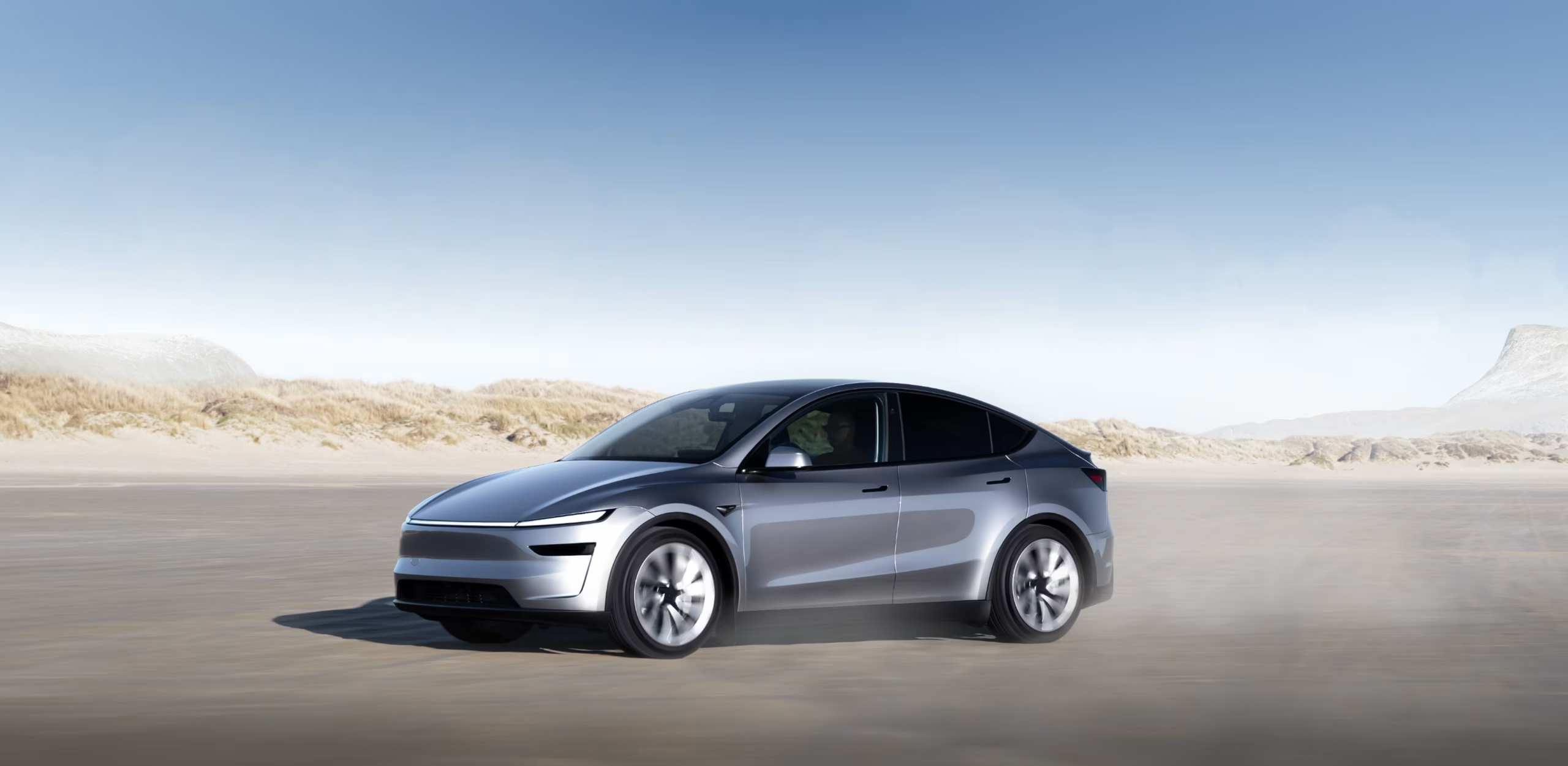
Why RWD Matters in a Tesla SUV
For many electric-vehicle (EV) buyers in the U.S., the decision comes down to “how much range do I need, and what kind of drivetrain do I want?”. In the lineup of the Model Y, the rear-wheel‐drive (RWD) version represents a strategic choice: typically less expensive than dual‐motor all‐wheel‐drive (AWD) versions, often slightly slower in acceleration, but potentially offering advantages in range, simplicity, maintenance, and cost of ownership.
If you’re searching for “Tesla Model Y RWD” (or “Tesla Model Y and RWD”), this article will walk you through everything you need to know — especially for U.S. buyers — so you can determine whether the RWD version is the right fit for your lifestyle, budget, and driving habits.
What “RWD” Means for the Model Y
“RWD” stands for rear-wheel drive, meaning the vehicle’s single electric motor drives the rear wheels only, rather than employing a second motor on the front axle (which results in AWD). In the context of the Model Y:
- The RWD version uses a single rear motor rather than the dual-motor setup of many AWD versions.
- Because there’s only one motor and only the rear wheels are driven, there are fewer mechanical complexities: fewer motors, no front axle drive components, and in many cases simpler control systems.
- RWD versions often weigh slightly less (since no front motor) and can deliver slightly better efficiency (all else equal).
- On the other hand, AWD versions typically offer better traction (especially in poor weather), quicker acceleration, and perhaps a bit more stability in certain driving situations.
For the Model Y, Tesla has offered — at times — RWD versions and long‐range RWD versions (depending on market and year). For example: one spec source shows a “Model Y Standard RWD (Juniper)” version. Other resources note the Model Y RWD tech specs (e.g., power: ~220 kW / ~295 hp; torque ~430 Nm) for some RWD variants.
In short: Choosing the RWD Model Y means opting for the simpler drivetrain, likely lower cost, but you may sacrifice some performance and perhaps some all‐weather traction compared to AWD.
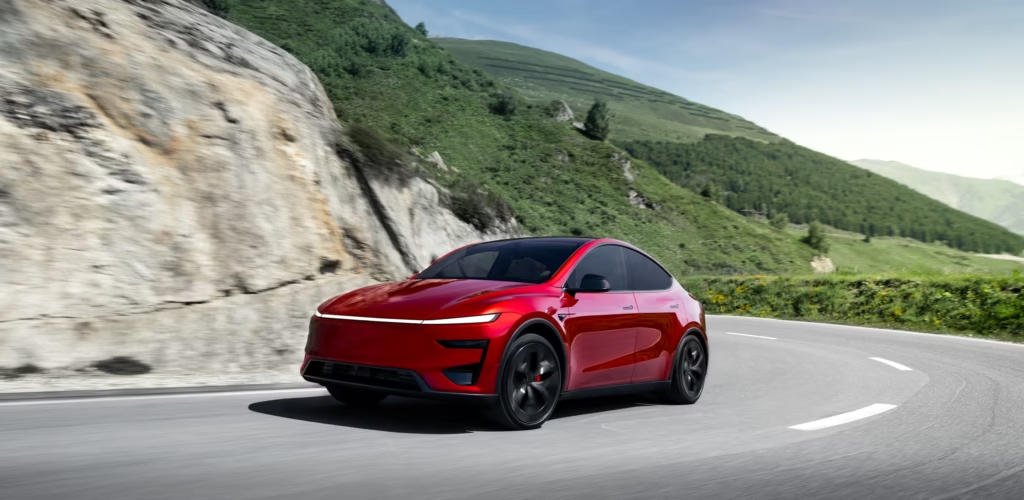
What Tesla’s Official Site Says About the Model Y
It’s important to anchor our discussion with what the manufacturer (Tesla) officially states. According to Tesla’s U.S. Model Y webpage:
- The “Model Y Premium Specs” section lists a Long Range AWD version with an estimated EPA range of 327 mi (for the AWD dual‐motor configuration) and acceleration of 4.6 s 0-60 mph.
- The site shows the “Drive” options as “All-Wheel Drive” or “Rear-Wheel Drive”.
- Dimensions & features: for example, weight (curb mass) ~4,396 lbs; cargo capacity ~76 cu ft; wheels 19″ or 20″; seating for 5 adults; displays: 15.4″ centre touchscreen + 8″ rear touchscreen.
- From the “Compare” page (on Tesla’s website) you can see listed U.S. starting prices (before destination & fees) for: Model Y Standard Rear-Wheel Drive at ~$41,630; Model Y Premium Rear‐Wheel Drive at ~$46,630; Model Y Premium All-Wheel Drive ~$50,630.
This means Tesla positions the Model Y RWD (and AWD) in a clearly tiered format: RWD as entry or value trim, AWD as higher performance/traction trim. For buyers searching “Model Y RWD”, this gives context of how Tesla presents its options.
U.S. Market Availability & Pricing of the Model Y RWD
For U.S. buyers, understanding when the RWD version was available, what the pricing was, and what you’re getting is essential.
- According to Tesla’s Compare page, the starting U.S. price for a Model Y Standard RWD is ~$41,630 (before destination & fees) as of the last update.
- The Model Y Premium RWD starts at ~$46,630.
- Spec-sheet sources show for 2024 RWD (limited availability) motor output ~295 hp.
- Recent spec sites indicate a 2025 Long Range RWD version with ~357 miles EPA estimate and 0-60 mph ~5.4 s.
- Other sources (for non-U.S. market) list real-world range ~385 km (~239 miles) for RWD versions.
Key take-aways for U.S. buyers:
- At time of writing, the RWD version presents the best “value” entry point into the Model Y family (assuming pricing remains).
- Incentives (federal tax credits, state incentives) may apply differently depending on model, purchase date, battery sourcing, etc., so always check current eligibility.
- Because Tesla shifts trim availability and pricing often, you’ll want to confirm current pricing on Tesla’s U.S. website for your state.
Performance, Range & Efficiency of the Model Y RWD
One of the biggest questions prospective buyers have is: “How does the RWD version perform — and is the range good enough for my daily needs?”
Here are some key data points:
Range
- The EV Database reports a “Standard RWD (Juniper)” version of the Model Y with an estimated real range of ~385 km (~239 miles).
- ArenaEV shows for the 2025 Long Range RWD version: 357 miles EPA (386 miles WLTP) for the RWD version.
- Some older specs for RWD versions list the power at ~295 hp, but range not always clearly specified for U.S. EPA.
Performance (0-60 mph, top speed)
- For certain RWD versions: 0-60 mph in ~5.4 seconds (ArenaEV spec) for 2025 Long Range RWD.
- Other RWD specs: 0-100 km/h (~0-62 mph) in ~6.9 seconds.
- Top speed for some RWD versions: ~125 mph (~201 km/h) per ArenaEV spec for 2025 Long Range RWD.
Efficiency and Battery
- Some sources note usable battery capacity of ~60.5 kWh for certain RWD versions.
- Because RWD versions skip the second motor, they can be slightly more efficient in mild weather/steady driving compared to AWD equivalents.
What this means in practice
- For many U.S. drivers, range of ~300+ miles (or nearly that) is more than sufficient for daily commuting + moderate road travel.
- The performance is still strong — 5-6 seconds 0-60 is quick for most drivers; only “performance-enthusiasts” might demand sub-4-second times (which usually come in Performance/AWD trims).
- If you live in a region with inclement weather (snow, heavy rain) or drive often on slippery surfaces, you might notice the difference between RWD and AWD more.
- Charging infrastructure (especially via Tesla Supercharger network) helps mitigate “range anxiety”, but you’ll still want to plan if you do long-road trips.
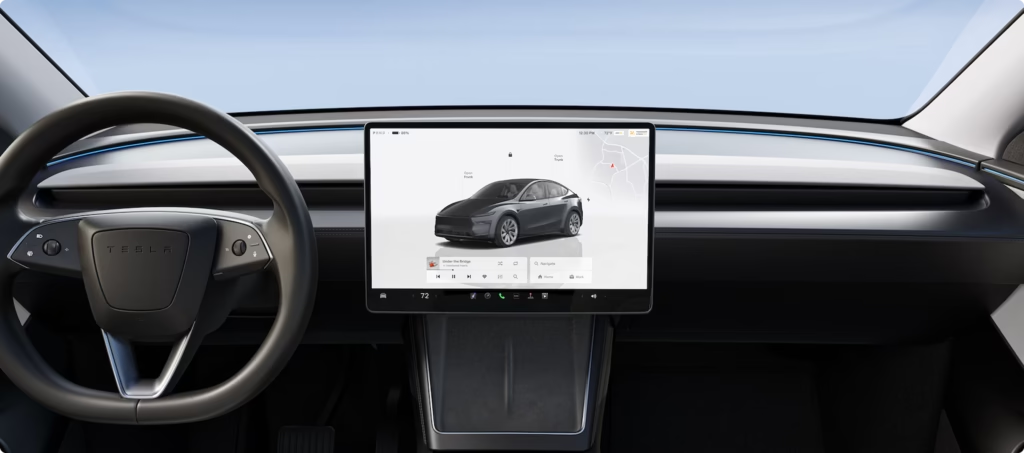
Features & Equipment: What’s Included (and What’s Not)
Choosing the RWD version often means the same “look and feel” of the Model Y platform, but there might be differences in standard equipment and optional upgrades. Here are some considerations:
Standard Equipment
- As a Tesla, you still get many of its signature features: large central touchscreen, Tesla software ecosystem (over-the-air updates), good cabin space, glass roof (depending on trim), and access to the Tesla Supercharger network.
- Many RWD versions share much of the premium interior and infotainment tech of the higher trim versions (depending on region) per reports. For example, one article noted the refreshed Model Y LR RWD in the U.S. retains “premium interior and audio options”.
What may be reduced or optional
- Some features that come standard in higher trims (AWD or Performance) might be optional or absent in lower-cost RWD versions. E.g., fewer speakers, simpler wheels, less aggressive suspension, no second motor, possibly fewer premium upgrade options.
- You should check the Tesla website for the specific model year you are looking at, because Tesla’s configuration and feature list change frequently. For example, earlier Model Y RWD versions had slightly different battery/capacity.
- If the tax credit/incentive qualification is dependent on certain battery or production conditions, features/capacity may reflect that.
- When choosing used/older RWD models, check if software upgrades (Full Self-Driving, Autopilot) are included or optional.
Interior and comfort
- As with Tesla generally, expect minimalist interior design, large touchscreen interface, a glass canopy roof (depending on version), good cargo space for an SUV, and strong tech.
- RWD versions being less expensive may mean some materials or optional packages are omitted; if interior premium feel is important (e.g., for long commutes or family trips), you’ll want to compare sample cabins or test drive.
Pros & Cons of Choosing the RWD Version
Here’s a balanced breakdown of the advantages and disadvantages of opting for the Model Y RWD, especially relevant for U.S. buyers.
Pros
- Lower cost: Because it uses only a single motor and simpler drivetrain, RWD is typically less expensive to buy (all else equal) than the equivalent AWD or Performance trims.
- Good range for value: The RWD version offers a strong balance — you still get substantial range (300+ miles in many cases) without paying the premium for dual motor.
- Simplicity: Fewer moving parts (no front motor) might translate into slightly lower maintenance (though EVs generally require low maintenance anyway).
- Efficiency: In certain driving conditions, RWD may result in slightly better efficiency because you’re not powering a front motor when not needed.
Cons
- Traction in slippery conditions: AWD versions offer better grip in snow/ice/rain. If you live in a region with heavy winters or poor road conditions, AWD might be safer.
- Performance trade-off: RWD typically accelerates slower than dual-motor versions. If you care about “fastest possible 0-60” times, you might feel the difference.
- Future resale value: Depending on market demand, AWD or Performance variants may hold value differently than RWD. (Though that depends a lot on region, condition, and Tesla’s brand perception.)
- Feature differences: Possibly fewer premium options, depending on trim and year; you’ll want to check for any omitted features.
Comparing Model Y RWD vs. AWD and Performance Variants
To make a smart buying choice, it helps to compare how the RWD version stacks up against the AWD and Performance versions of the Model Y.
| Variant | Drivetrain | Typical 0-60 mph* | Range (approx) | Cost | Best for |
|---|---|---|---|---|---|
| RWD | Single rear motor | ~5.4–6.0 s | ~300–360+ miles (depending on battery/trims) | Lowest cost | Value oriented buyers, moderate driving conditions |
| AWD (Dual Motor) | Rear + front motors | ~4.6-5.0 s | Slightly less range than RWD (due to extra motor/weight) | Higher cost | Better performance, all-weather capability |
| Performance (Dual Motor + sport upgrades) | Rear + front motors, performance tuning | ~3.3-4.5 s | Lowest range in the lineup | Highest cost | Enthusiasts, performance‐focused buyers |
*Example numbers: RWD 0-60 ~5.4 s (ArenaEV 2025 LR RWD spec)
The Verge article referenced 5.4 s for RWD.
What to focus on when comparing:
- Cost vs benefit: How much more does AWD cost and is the extra cost worth it for your use case?
- Driving environment: If you live in a snowy/icy region, AWD may be more beneficial.
- Range vs speed: If you prioritise range and daily commuting, RWD may deliver better value. If speed and performance matter, go higher.
- Resale & demand: Research how RWD versions are selling/holding value in your region.
- Incentives: Sometimes eligibility for tax credits or incentives depends on battery size, manufacturing location, or version — check carefully.
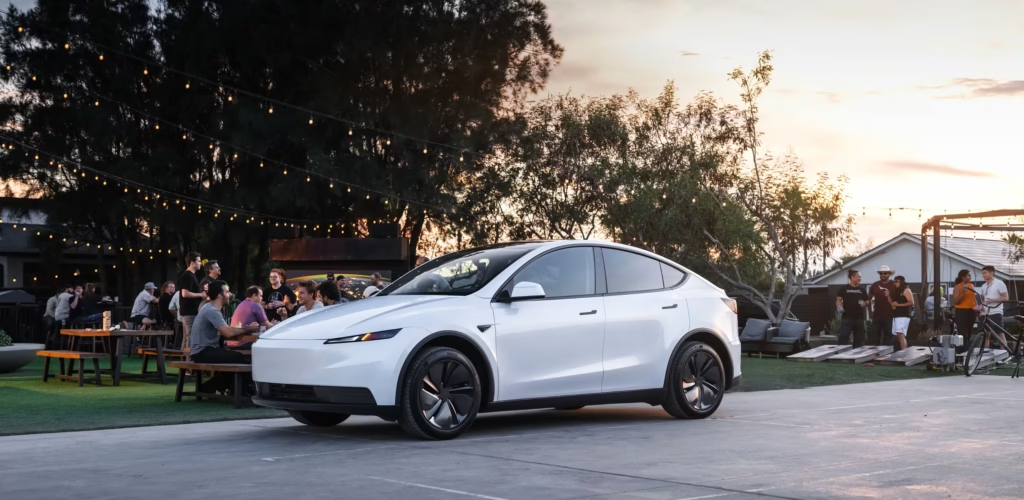
Who Should Consider the Model Y RWD?
Here are some typical buyer profiles for which the RWD variant of the Model Y is especially suitable:
- Daily commuter: If your commuting distance is moderate (e.g., 20–50 miles a day) and you want a Tesla SUV at the lowest possible entry cost, RWD makes sense.
- Budget-conscious EV buyer: You want Tesla brand, access to Superchargers, all the tech, but you don’t need the fastest version or don’t drive in extreme conditions.
- Mild‐weather region: If you live in a region where winters are mild or you have a garage/covered parking and you don’t face lots of snow/ice, the traction difference may matter less.
- Range-focused rather than speed-focused: If your main concern is how far you can go between charges (rather than how fast you can sprint), the RWD is a strong value.
- First EV buyer: If you’re getting into EVs and want to start with something capable but not super expensive, the RWD is a good stepping stone.
On the flip side, the RWD may be less ideal if: you frequently travel in harsh weather, live where AWD is a strong asset, you care deeply about fastest performance, or you plan to use the vehicle in heavy towing (if applicable) or severe terrain.
Buying Tips: Incentives, Tax Credits, Resale & Value
When buying a Model Y RWD (or any Tesla EV) in the U.S., keep these key buying tips in mind:
Federal Tax Credit and Incentives
- The U.S. federal EV tax credit (under the Inflation Reduction Act) may apply depending on the vehicle’s price, battery sourcing, manufacturing location, and other criteria. Confirm whether the specific RWD model you’re looking at qualifies.
- Some state incentives (rebates, HOV lane access, local utility credits) may vary by state.
- Timing matters. Tesla often changes pricing/trim options mid year; if an incentive is about to expire or trim availability changes, being aware is helpful.
Resale Value & Depreciation
- Tesla models generally hold value well compared to many vehicles, but check the used EV market in your state.
- Keep in mind: battery health, software updates, mileage, and condition will affect the value.
- With RWD, because it’s a simpler configuration, some buyers may prefer the “premium” AWD versions — so check how used RWD models are performing in your region.
Configuration & Options
- When ordering or buying used, check the exact configuration: battery size, motor, wheels, interior, features (e.g., Full Self-Driving package). A “RWD” label may cover a number of variants.
- Test drive if possible. Even though EVs have fewer moving parts, how the car feels (suspension, cabin noise, ride comfort) can vary.
- Charging infrastructure: If you live somewhere with Tesla Superchargers, be sure you understand charging cost, availability, speed. For road trips, range and charging speed matter.
Used Market
- If purchasing used: check battery condition, software update history, accident/repair history.
- RWD models may have fewer motors and simpler systems, which could be a plus for maintenance.
- Be aware of over‐the‐air updates from Tesla — used buyers should confirm features remain supported.
✅ Use our referral link: ts.la/jacob4310 — save on your Tesla and support our referral program at the same time.
Conclusion & Final Thoughts
The Tesla Model Y RWD version offers one of the most compelling value propositions in Tesla’s SUV lineup for U.S. buyers: “Tesla brand + good range + simpler drivetrain + lower cost than AWD/Performance”. If your driving habits, regional weather, budget and usage patterns align, the RWD version is a strong choice.
That said, you’ll want to evaluate your priorities: if you drive often in poor weather, need maximum traction, or care deeply about fastest performance, the AWD or Performance versions may justify their higher cost. But for many buyers — commuters, families, value-seeking EV adopters — the RWD hits a sweet spot.
Before you commit: check the exact model year, feature list, pricing, incentives, battery/charging network in your region, and resell prospects. For U.S. buyers looking for “Tesla Model Y and RWD”, this version is definitely worth serious consideration.
Model Y RWD (US) 2020–2025 Comparison
| Year | US Availability | Variant | EPA Range (mi) | 0–60 mph (s) | Motor / Drive | Battery notes | Launch MSRP (USD) | Key Notes |
|---|---|---|---|---|---|---|---|---|
| 2020 | No RWD offered in the U.S.; AWD & Performance only | — | — | — | — | — | — | Initial U.S. launch focused on AWD/Performance. |
| 2021 | Yes (Jan–Feb 2021); discontinued quickly | Standard Range RWD | 244 | 5.3 | Single motor, RWD | Undisclosed; entry pack | $41,990 | Briefly on sale; orders stopped in Feb 2021. |
| 2022 | No RWD on sale | — | — | — | — | — | — | Long Range RWD canceled for U.S. deliveries in Dec 2021. |
| 2023 | Yes (Oct 2023 reintroduction) | Standard Range RWD | 260 | 6.6 | Single motor, RWD | Likely LFP; 170 kW peak charge reported | $43,990 | Reintroduced as entry Model Y in U.S. |
| 2024 | Standard RWD pulled; LR RWD appears (software-unlock narrative) | Long Range RWD (reports) | — | — | Single motor, RWD | SR RWD software-capped to 260 mi; unlockable to LR pending approval | — | Transition period from SR RWD to LR RWD in U.S. |
| 2025 | Yes | Long Range RWD | 357 | 5.4 | Single motor, RWD | Pack size not officially disclosed | $45,990 | Positioned as value trim with longest range vs AWD. |
Frequently Asked Questions (FAQ)
Does the Model Y RWD get the same Tesla Supercharger access as AWD versions?
Yes — all Tesla Model Y variants (including RWD) have access to the Supercharger network, assuming you buy new or within the applicable policy.
What about weather performance (snow, ice) for RWD?
RWD inherently has less traction than AWD in low‐grip conditions. If you drive in heavy snow or icy roads frequently, you may prefer AWD. That said, good winter tires and driving prudence mitigate a lot of risk.
How does the range of RWD compare to Supercharger charging speed?
Range often depends not just on battery size but on driving style, weather, terrain, wheels/tyres. Some RWD versions report ~300–360 miles. Charging speed is largely a function of Tesla’s Supercharger network, battery pre‐conditioning and version’s peak charging capability. For specific peak charging numbers, check Tesla’s website for that model year.
Are there any major drawbacks to RWD I should worry about?
Some potential drawbacks: slower acceleration compared to AWD/Performance, possibly less grip in challenging weather, maybe fewer premium options depending on trim. But for many drivers, those trade‐offs are minor relative to cost savings.
Will Tesla discontinue RWD versions?
Tesla’s model lineup evolves frequently; availability of RWD vs AWD versions may change by region and model year. It’s wise to check Tesla’s official U.S. site at the time of purchase to confirm exactly which trims are available and their specs.